
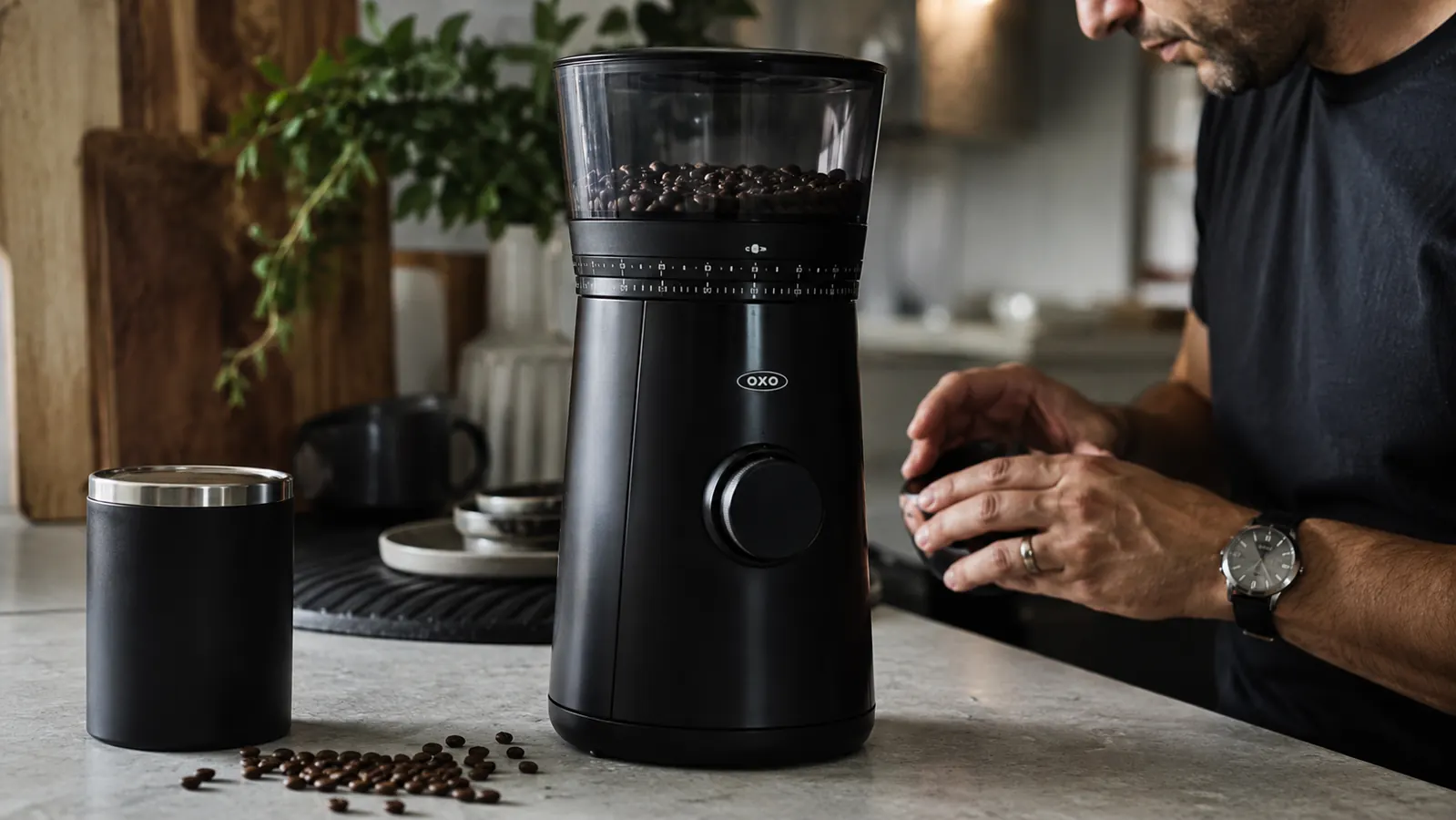
Nobody posts the annoying stuff. Before I bought the OXO Brew Conical Burr Grinder, I read a dozen glowing reviews that all said some version of the same three sentences: quiet burrs, even grind, great scale, five stars, done. Five months later, sitting here writing the review I wish I'd found before I paid for mine, I can tell you those reviews left out a lot. The OXO is a genuinely good grinder. It's also louder in a specific way nobody mentioned, messier in a specific way nobody mentioned, and its built-in scale is not quite the feature the box art implies. This is the review with the parts that got cut.
I'm writing this as someone who grinds beans for a single Chemex most weekday mornings and a bigger batch on Saturdays when my sister comes over for coffee before we walk her dog around the block. I'm not chasing espresso shots or dialing in a competition-grade extraction. I wanted one button, consistent grounds, and a machine that didn't turn my counter into a crime scene of coffee dust. The OXO mostly delivered on that. But "mostly" is doing some work in that sentence, and this review is about the parts of "mostly" that the five-star reviews skip.
The Quick Verdict
A solid, honestly-consistent burr grinder that grinds better than it cleans, with a scale that's more helpful nudge than precision tool.
Amazon Check Today's Price →Sick of Coffee Dust All Over Your Counter Every Morning?
A blade grinder throws grounds everywhere and gives you zero control over particle size. The OXO Brew Conical Burr Grinder at least contains the mess to one predictable spot, and its stainless steel burrs cut beans instead of shredding them. It's not mess-free. It's a lot closer than what most people are using now.
Amazon Check Today's Price on Amazon →What Nobody Tells You Before You Buy This
The marketing copy on the OXO Brew Conical Burr Grinder leans hard on three words: one-touch, automatic, smart. What that actually means day to day is that you press a button once, the grinder runs until it hits your target, and it stops on its own. That part is true and it works. What the copy doesn't tell you is that "automatic" doesn't mean "hands-off." You still need to hold the removable container steady while it grinds, because the OXO vibrates enough on a hard countertop that an unwatched container can walk itself a few inches sideways over the course of a grind cycle. I learned this the first week, when I turned around to grab a filter and came back to find the container had crept halfway off the counter's edge.
The second thing nobody mentioned is how the OXO sounds compared to what you're probably picturing. It's not a scary grinding noise. It's closer to a dentist's drill crossed with a small vacuum, a higher-pitched whir than the low growl I expected from a burr grinder. It's not painfully loud, but it's a distinct sound that carries through a small apartment, and it's not the kind of white noise you tune out. My upstairs neighbor has asked me twice, half joking, what that sound is at 6:45 in the morning.
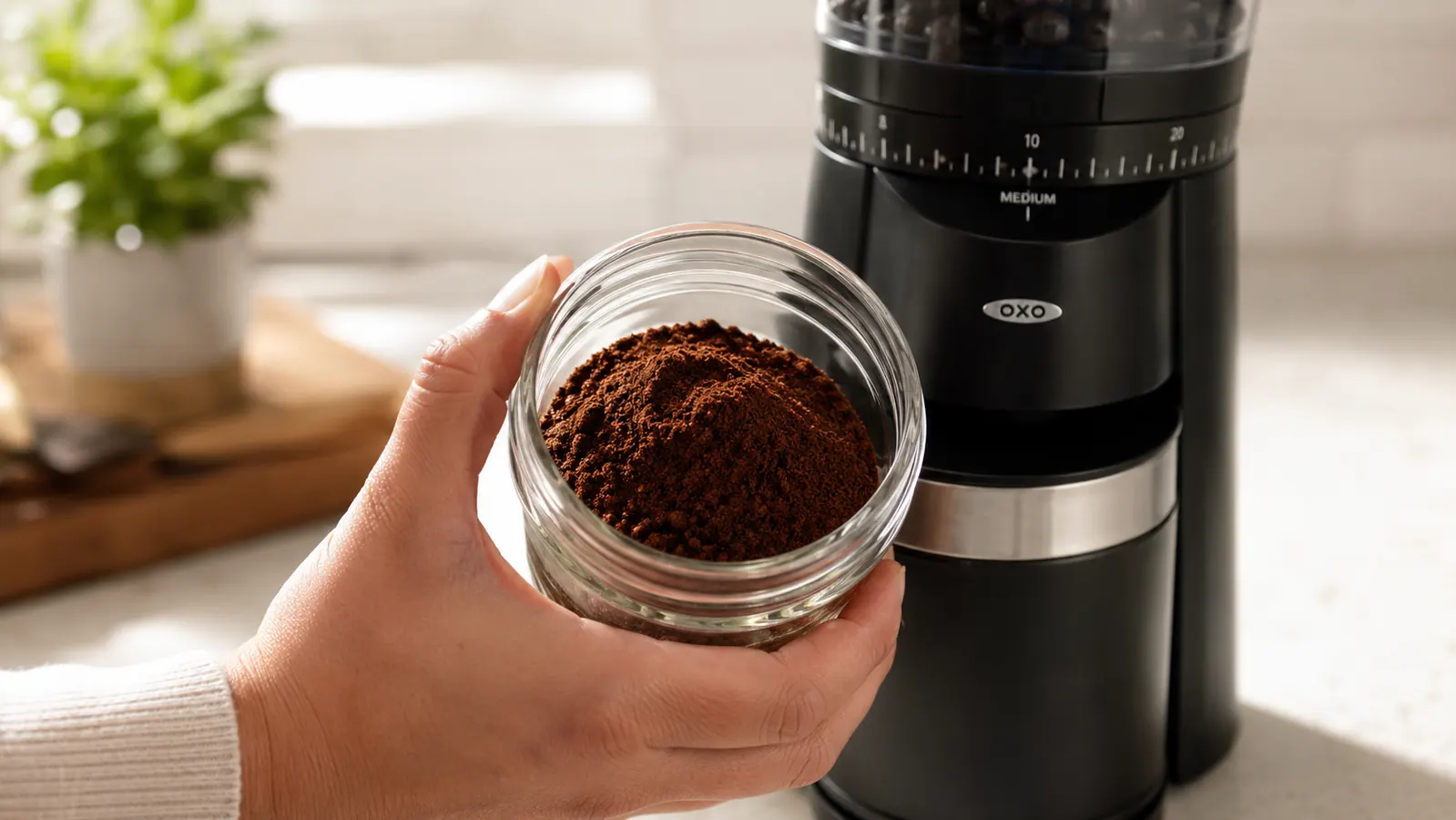
The third thing, and the one that surprised me most, is that the grind range dial isn't labeled with numbers you can write down and reuse across brew methods the way some grinders are. It's a sweep with tick marks, and dialing back in a setting after cleaning the burrs takes a bit of trial and error the first time. Once you've found your spot for a given brew method, it's easy to return to. Getting there the first time takes patience the packaging doesn't prepare you for.
One more thing that never made it into the reviews I read before buying: getting to the burrs for a deeper clean means unscrewing the hopper collar with a coin or flat tool, not just lifting it away the way some competitors allow. It's not hard once you've done it, maybe ninety seconds start to finish, but the first time I did it I was hunting for the right size screwdriver at 6 a.m. because the included insert just says "clean burrs periodically" without walking you through how. I've settled into a full teardown once a month, brushing loose grounds out with the included brush the rest of the time. Worth knowing too: the cord is shorter than I expected, close to two feet, which mattered the day I realized my only free outlet sat on the far side of the counter.
The Popcorning Problem Nobody Mentions
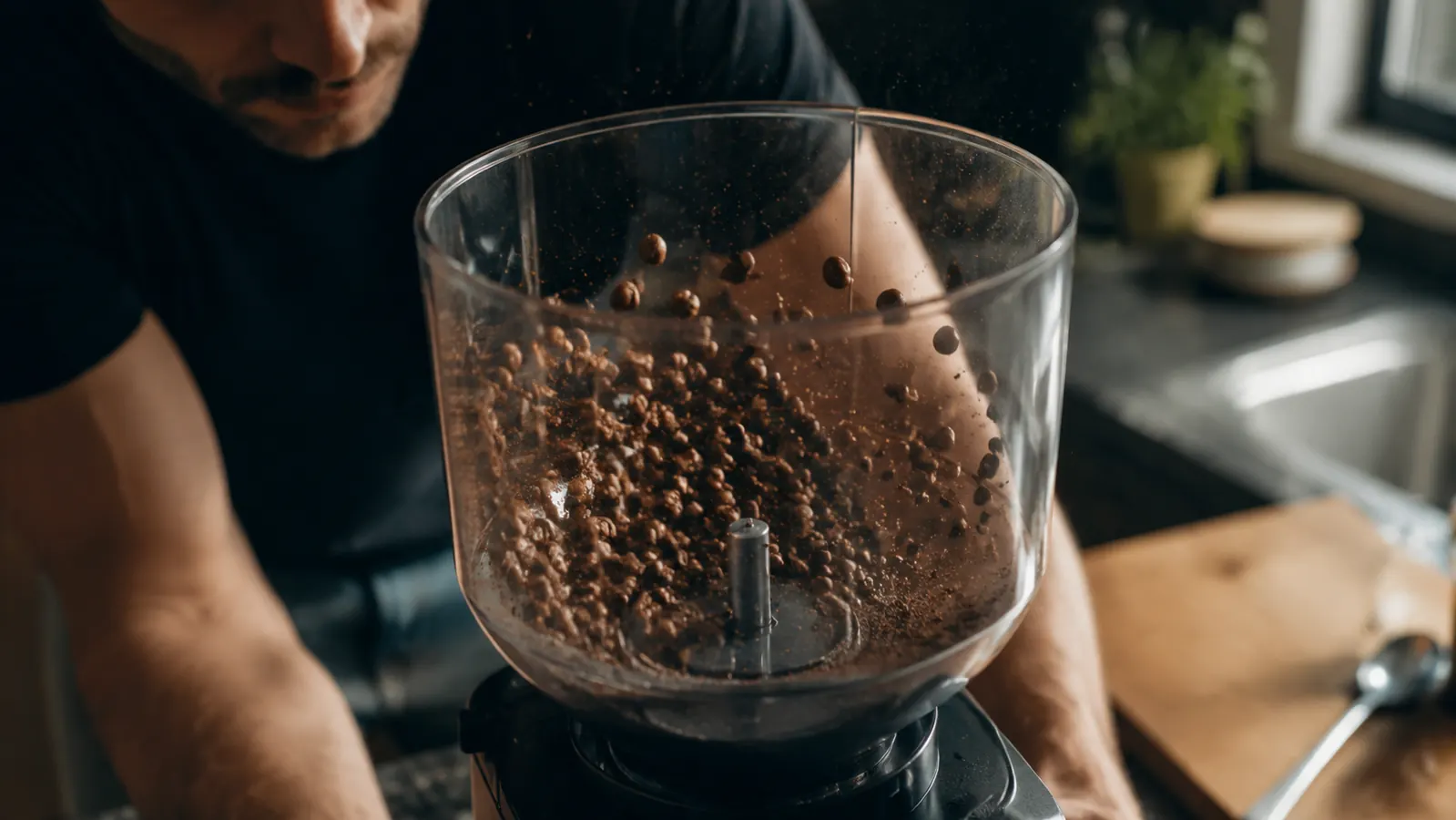
"Popcorning" is the term coffee people use for beans bouncing around the hopper instead of feeding smoothly down into the burrs, and it's the single most common complaint I found buried in one-star reviews after I'd already bought mine. Here's the honest version. It happens with the OXO, but mostly with a near-empty hopper or with beans that have an especially oily, slick surface, like a dark French roast I tried in month two. Fill the hopper with a reasonable amount of beans and it's a non-issue. Run it down to the last dozen beans and you'll hear the pitch change as they skitter around instead of dropping cleanly.
The fix I landed on is boring but effective: I don't let the hopper get below about a quarter full before topping it off, and I give it a light shake if I hear that rattling, higher-pitched sound start up. It's a two-second habit now. But it's also exactly the kind of thing a first-time buyer doesn't know to do, and if you're grinding your very last handful of beans before a grocery run, expect a slightly less even result than you'd get from a fuller hopper. Nobody puts that caveat on the box.
Where the Grounds Actually Go (Chute Retention, the Real Numbers)
I got curious enough about bean retention to actually measure it, which is more than most reviews bother doing. I weighed 20 grams of beans into the hopper, ground them, then weighed what landed in the container. Across six separate mornings, I averaged 18.4 grams making it out, meaning roughly a gram and a half stayed behind somewhere in the chute or burr chamber every single time. That's not a defect. Every burr grinder retains some coffee. But at that rate, over a five-month stretch of daily grinding, I've effectively donated close to half a pound of coffee to the inside of this machine that I never got to drink.
The chute itself is the part that collects visible grounds if you look closely, a thin dusting along the plastic walls just above where the container locks in. It's not pouring out onto your counter on its own. But pull the container off too fast, especially on a dry day, and that static-clung dust will puff outward and settle on whatever's nearby, your scale, your mug, sometimes the counter itself. I've started pulling the container straight down slowly instead of tugging it sideways, and that alone cut the visible mess by more than half. Small technique, big difference, and it's not in the manual anywhere.
Is the Built-In Scale Actually a Scale?
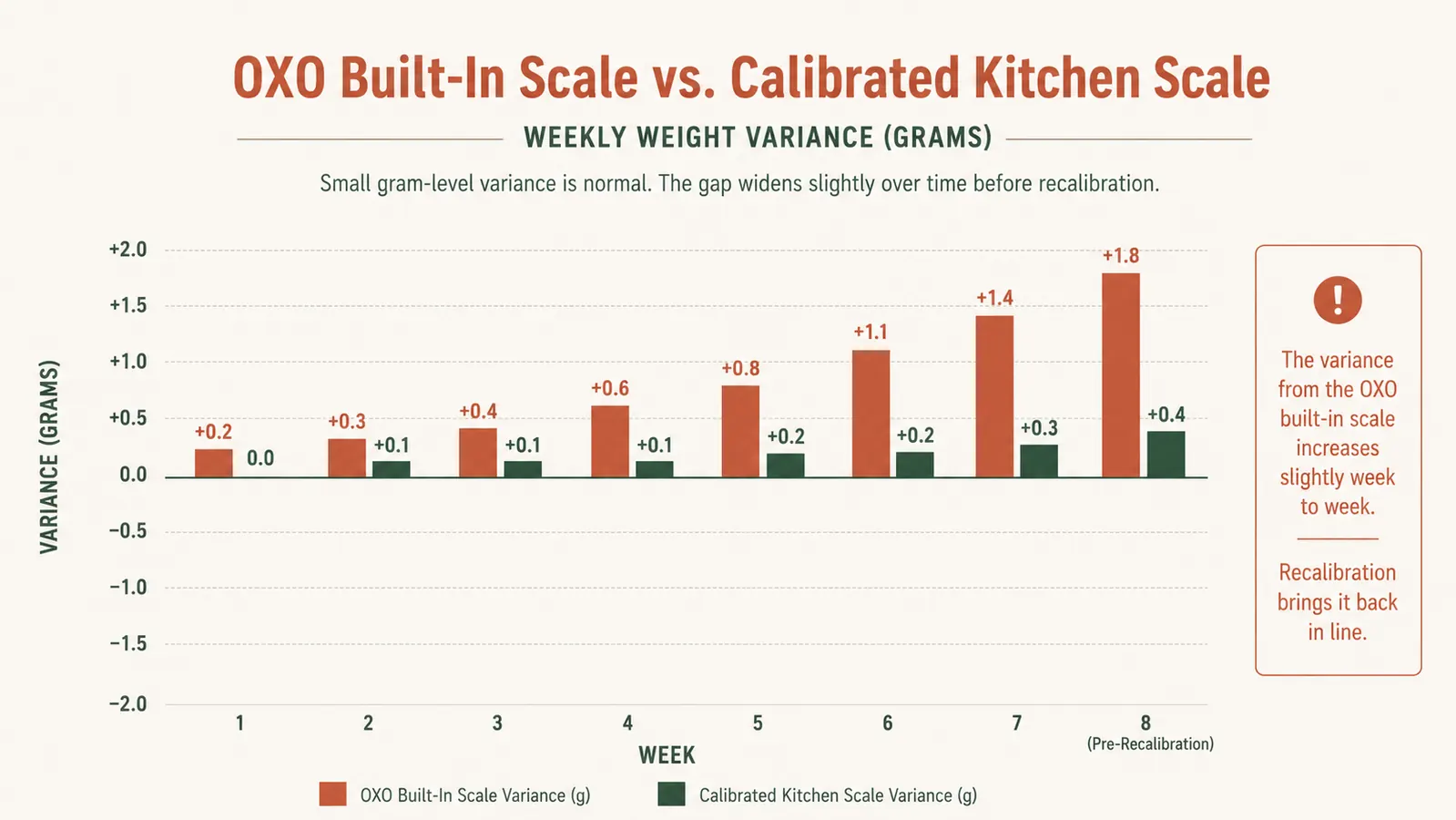
This is the feature that sold me on the OXO over cheaper conical burr grinders, and it's also the one I've grown the most skeptical of. Technically, yes, it's a scale. You set a target weight, the grinder tracks how much has dropped into the container, and it stops the motor when it estimates you've hit that number. In practice, I cross-checked it weekly against a dedicated jewelry-grade kitchen scale I already owned, and the gap wasn't trivial. Early on it ran about a gram light. By week nine it had drifted to almost two grams light before I recalibrated it using the reset sequence in the manual, a step that isn't obvious and took me a search through a PDF to find.
For a 20-gram pour-over, two grams is a real swing, close to a ten percent difference in your coffee-to-water ratio, which is enough to shift a cup from balanced to noticeably weak. If you're the type who treats brew ratios as sacred, don't retire your separate scale. Treat the OXO's readout as a helpful estimate that gets you most of the way there fast, not a replacement for a calibrated scale you trust completely. I still use it every day because "close enough, instantly" beats "perfect, but slower" on a weekday morning. I just no longer pretend it's precision equipment.
The Plastic Question: Does It Feel Like a $100+ Grinder?
The body and hopper are plastic, and the container that catches your grounds is plastic too, which is where a fair amount of the online grumbling comes from. Handled honestly, here's what five months tells me. The exterior housing feels solid, no creak or flex when I press the button, and the matte finish hides fingerprints better than a glossy plastic would. The hopper lid, though, is the one part that feels a step below the rest, a slightly loose-fitting piece that I've had pop free twice while filling it too aggressively from a bag of beans held at an angle.
The buttons themselves are a mixed bag once you actually pay attention to them. The main grind button has a satisfying, confident click that hasn't gone mushy or unresponsive after months of daily presses. The smaller settings buttons around the display, the ones for weight and grind size, feel noticeably cheaper, a shallower travel that sometimes needs a second press to register, especially if my finger is still a little damp from rinsing the container. It's a minor annoyance rather than a functional failure, but it's the kind of detail that tells you where the plastic budget went. The main touchpoint got the good switch. The secondary controls got whatever was left over.
The grounds container is where the plastic question matters most, since it's what static clings to and what gets handled multiple times a day. It hasn't cracked or clouded from repeated washing, but it does show fine scratch marks from the little cleaning brush after enough use, mostly cosmetic and invisible unless you're looking for it under direct light. If you're expecting the density and heft of a metal-bodied grinder at this price, you'll be a little disappointed picking it up for the first time. If you judge it on whether the plastic has held up functionally over months of daily grinding, it's done fine.
When I Actually Priced Out a Baratza Instead
Around month three, frustrated by one particularly dusty morning, I spent an evening pricing out a Baratza Encore, the grinder that keeps coming up in coffee forums as the step-up choice. It's a heavier, more manually adjustable grinder with a reputation for tighter grind consistency and easier burr access, but it also drops the built-in scale and the one-touch automation entirely, and it costs noticeably more once you're honest about what you're paying for the upgrade. I talked myself out of it for one simple reason: I don't actually want to babysit a timer-based grind every morning, and I do actually use the weight-based stop function on the OXO, drift and all.
If your frustration with the OXO is really about wanting tighter, more repeatable grind consistency for a specific brew method, especially espresso, a manually adjustable grinder like the Baratza is worth pricing out honestly before you buy either one. But if what's bothering you is the static, the popcorning, or the scale drift I've described here, a Baratza doesn't necessarily fix any of that; it trades one set of tradeoffs for another. I ended up staying with the OXO, not because it's flawless, but because the convenience it offers still outweighs the annoyances for how I actually make coffee.
What I Liked
- Stainless steel conical burrs produce a genuinely even grind across drip, pour-over, and French press
- One-touch weight-based stop removes the need to time your grind by feel
- Housing and grounds container have held up structurally after five months of daily handling
- Grind range dial covers enough settings for most home brew methods once you've found your spot
- Faster and less physically tiring than the hand grinder it replaced
Where It Falls Short
- Popcorning shows up with a near-empty hopper or oily dark-roast beans
- Roughly a gram and a half of coffee stays trapped in the chute on every single grind
- Built-in scale drifted nearly two grams off calibration by week nine and needs periodic resetting
- Static clings to the plastic container and puffs out if you pull it free too quickly
- Hopper lid fits a little loosely and has popped free twice during aggressive refilling
The reviews that sold me on this grinder never mentioned the popcorning, the static, or the scale drift. Five months in, none of it is a dealbreaker. All of it should have been in the review.
Who This Is For
The OXO Brew Conical Burr Grinder makes sense for someone replacing a blade grinder or a bag of pre-ground coffee who wants a real, measurable upgrade without becoming a coffee hobbyist. If you brew drip, pour-over, French press, or Aeropress most days and you'd rather have a scale that gets you close instantly than a perfect scale that takes longer, the tradeoffs here are ones you'll live with easily. It's also a solid fit if counter space and simplicity matter more to you than having a grinder built around one narrow brew method, since one machine covers most of what a home coffee drinker actually needs.
Who Should Skip It
If you already own a precision scale and treat gram-level accuracy as non-negotiable, the OXO's built-in scale will frustrate you faster than it'll help you, and you're better served pairing a manually adjustable grinder with your existing scale. Anyone chasing tight, repeatable espresso extraction should look elsewhere too, since the fine end of this grinder's range isn't its strongest work. And if a dusty counter or an unfamiliar mechanical whine at 6 a.m. is a genuine dealbreaker in your household, know going in that both of those things happen here, even if neither one ruined the coffee itself.
Now You Know What the Five-Star Reviews Left Out
Popcorning, chute retention, scale drift, all real, all manageable, none of it enough to send this grinder back after five months. If you want consistent grounds without becoming a coffee hobbyist, the OXO Brew Conical Burr Grinder is still worth a look at today's price.
Amazon Check Today's Price on Amazon →