

I almost sent the Cosori Food Dehydrator back before it ever touched food. Not because it didn't work, but because of the smell. I unboxed it on a Tuesday night, plugged it in, and ran the empty pre-season cycle the manual recommends before your first real batch. By hour two, my kitchen smelled like a new shower curtain left folded in a warm car. That's not a detail most five-star reviews mention, and it's exactly the kind of thing that changes how you'd plan your first week with the unit. I run a small folding-table stand at my local farmers market on Saturdays, selling dried apple rings and jerky sticks, and I bought the Cosori specifically because the $40 round stackable dehydrator I'd been using for two years couldn't keep up with market-week volume.
This isn't a takedown. The Cosori dries food well. The 165F top setting gets jerky to a safe internal temperature without me hovering over it, and the digital timer means I'm not resetting a kitchen timer every ninety minutes and hoping I remember. But there's a gap between what the product photos imply and what six months and roughly 60 batches actually feel like, and that gap is what most reviews skip. This one covers the parts I wish someone had told me before I plugged it in, from the smell on day one to whether I'd have been just as happy with something cheaper.
The Quick Verdict
Reliable and genuinely useful for regular batches, but the fan noise, the counter footprint, and the real drying times deserve more attention than the marketing gives them.
Amazon Check Today's Price →Stop paying $9 a bag for jerky you could make for a fraction of that at home
The Cosori Food Dehydrator handles jerky, dried fruit, and herbs in one machine with a digital timer that runs up to 48 hours, so you're not babysitting a batch overnight.
Amazon Check Today's Price on Amazon →How I've Used It (and Almost Returned It)
My routine is built around Saturday market prep. Wednesday nights I slice five pounds of apples into rings for drying, Thursday I marinate flank steak or ground beef for jerky and load the trays before bed, and Friday afternoons I do a quick batch of whatever the garden gave me that week, usually cherry tomatoes or basil. The Cosori's five trays and adjustable 95F to 165F range cover all three jobs without switching appliances, which is the entire reason I upgraded from the smaller round unit in the first place.
I'll be honest that the first weekend nearly soured me on the whole purchase. Between the plastic smell during the pre-season run and a tray that wouldn't seat flush against the frame, I spent more time troubleshooting than actually drying anything. I called my sister, who dehydrates for her dogs' treats and has run three different machines over the years, and she talked me through what was normal breaking-in behavior versus what wasn't. Most of it turned out to be normal. Not all of it, and I'll get into which parts weren't below.
By week three, the routine had settled and the machine earned its counter space. I've since stopped running the round stackable entirely, though I kept it as a backup for small herb batches when I don't want to tie up the bigger unit for three hours over a handful of basil. But I want to walk through the specific friction points, because they're the difference between loving this thing by month two and giving up on it after two weeks, which I've watched happen to a coworker.
The First 48 Hours: Plastic Smell and a Tray That Wouldn't Sit Flat
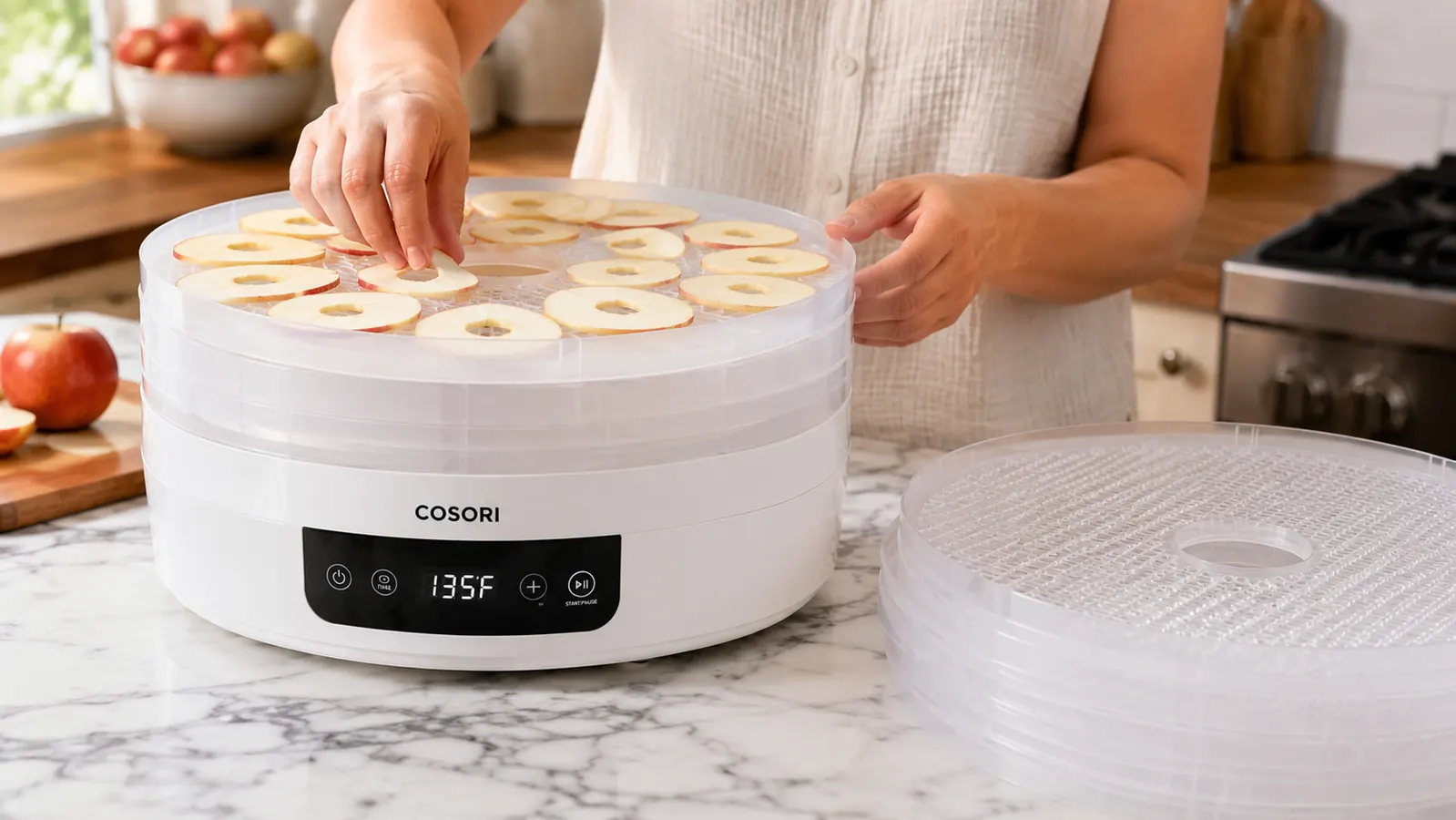
The manufacturer instructions ask you to run an empty cycle at a moderate temperature before your first food batch, to burn off manufacturing residue. I did that at 135F for two hours with the kitchen window cracked, and it still left a faint plastic odor that lingered into the next day. It never transferred into the food once I actually started drying, but if you're sensitive to new-appliance smells, plan that burn-in cycle for a day you can leave a window open and won't be cooking anything else nearby.
The tray issue was separate. One of my five trays had a slight warp along one edge straight out of the box, likely from how it sat in the packaging during shipping. It didn't seat flush against the frame, which left a narrow gap where warm air escaped instead of circulating across the food. I noticed it because that tray's apple rings were consistently less dry than the others after the same run time. Setting it in warm water for a few minutes and letting it cool flat under a stack of cookbooks mostly corrected it, though I still rotate that tray to the middle position rather than trusting it on the edges.
The counter footprint surprised me too. The unit measures close to 15 inches deep and stands over a foot tall with all five trays loaded, which is bigger than it looks in the marketing photos. It doesn't fit under my upper cabinets with the door hinged open for loading, so I have to slide it out several inches every time I add or check a tray. If your counter space is already tight, measure your actual clearance before assuming it'll live permanently under the cabinets like a coffee maker.
The Fan Noise Nobody Mentions in the Q&A
The Cosori uses a rear-mounted fan to circulate hot air across all five trays evenly, and it runs the entire time the unit is on, which for most of my batches is six to nine hours. It's not painfully loud, closer to a box fan on its lowest setting than anything jarring, but it's constant, and constant is different from loud when you're trying to sleep two rooms away with the door open.
I learned this the hard way during my first overnight jerky batch. I'm a light sleeper, and the steady hum carried further through my apartment than I expected. Now I run overnight batches in the mudroom off my kitchen instead of on the main counter, with the door mostly closed. If you live in a studio or small apartment where the kitchen is essentially part of the bedroom, factor that hum into where you'll actually run this thing at 2 a.m.
None of the Amazon Q&A threads I read before buying mentioned this, probably because most reviewers are answering during the day when ambient household noise covers it. It only becomes a real consideration for overnight jerky or fruit leather runs, which is exactly when a lot of us are running it, and it's worth weighing against wherever your kitchen sits relative to bedrooms in your own home.
Ten Hours Is Not a Suggestion, It's the Baseline
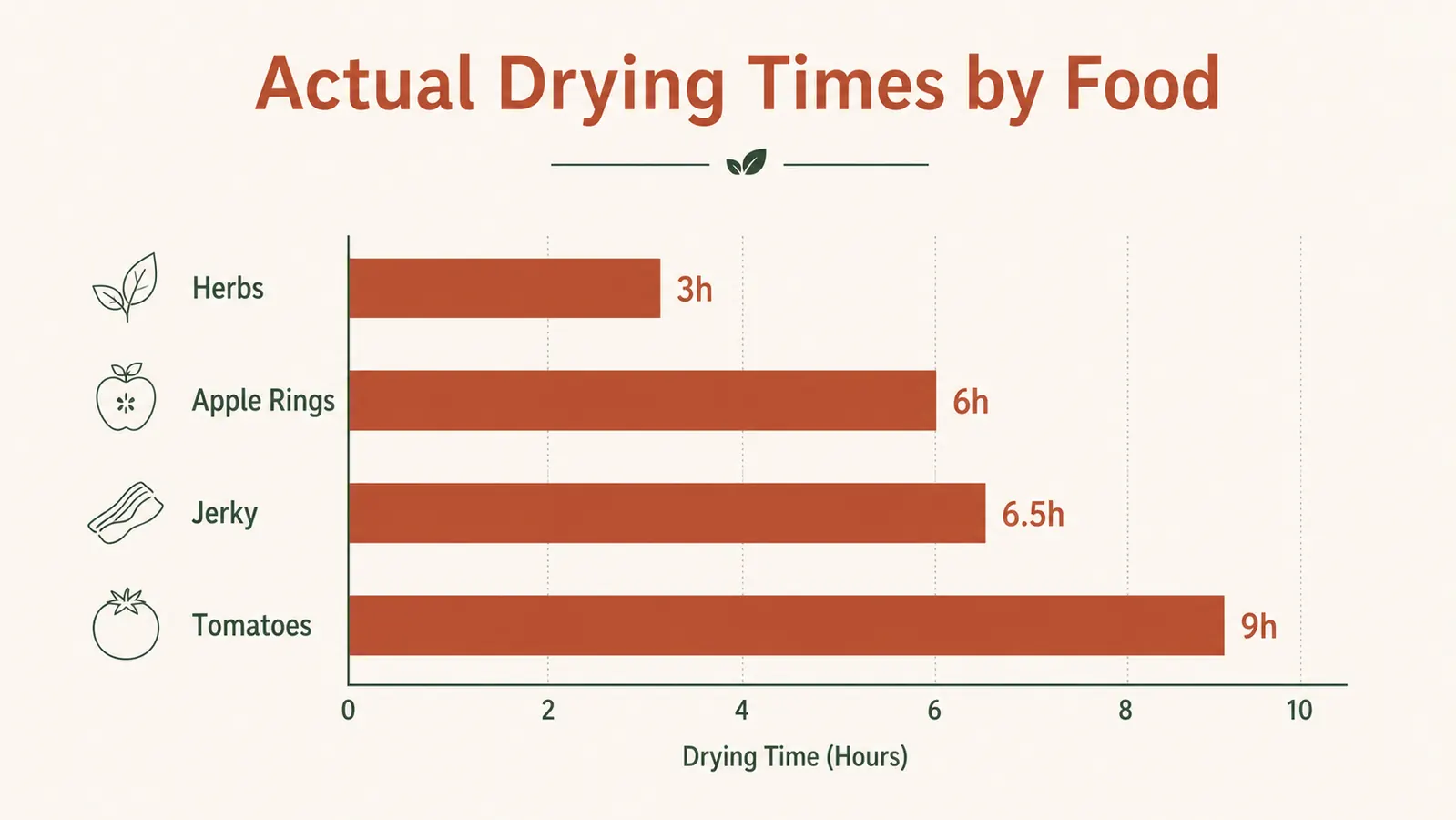
The box copy and most reviews I read before buying implied you could set a batch and check back in a few hours. In practice, drying times run longer and more variably than that framing suggests. Basil and oregano finish fastest, usually around three hours at 95F. Apple rings sliced a quarter-inch thick take six hours at 135F. Ground beef jerky at the 165F setting runs six and a half to seven hours depending on how thick I've spread it. Whole cherry tomatoes halved and dried at 135F are the slowest thing I make, routinely nine hours and sometimes closer to ten if the kitchen is humid.
The 48-hour digital timer is genuinely useful because it means I'm not guessing or resetting anything mid-batch, but I've learned to plan backward from when I need the food, not forward from when I start it. A Thursday night jerky batch that starts at 9 p.m. isn't ready until midafternoon Friday, not the next morning like I assumed the first time I used it. That single miscalculation cost me a market-morning scramble in my first month, and I now keep a small dry-erase calendar on the fridge just to track what's running and when it's due out.
If you're picturing this as a quick two-hour appliance you can run before dinner, recalibrate that expectation now. It's closer to a slow cooker in terms of time commitment, just spread across most of a workday or overnight instead of an afternoon.
Cleanup Takes Longer Than the Box Implies
The trays are listed as dishwasher-safe, and technically they are, but fruit leather and marinated jerky residue don't come off with a quick rinse cycle the way the packaging suggests. The mesh liner sheets especially trap sticky fruit residue in their weave, and I've found I get better results hand-washing those in warm soapy water within an hour of a batch finishing, before anything has a chance to fully set and harden into the mesh.
A full cleanup after a jerky batch, trays, mesh liners, and wiping down the interior fan housing where grease can spatter, runs me about fifteen to twenty minutes. That's not unreasonable for a machine drying five pounds of food at once, but it's not the two-minute wipe-down some reviews imply either. I keep a dedicated scrub brush just for the mesh trays now, since a regular sponge doesn't get into the weave well and tends to fall apart faster than it should.
The plastic housing itself needs almost no attention, just an occasional wipe of the control panel and the door. It's the trays and liners that account for nearly all the cleanup time, so if you're drying sticky things like fruit leather or heavily marinated jerky every week, budget that time into your routine rather than assuming it's a rinse-and-done appliance.

Would the Cheaper Presto Have Done the Job?
Before buying the Cosori, I seriously considered the Presto Dehydro, which runs noticeably cheaper and shows up in a lot of budget dehydrator roundups. I actually borrowed a friend's Presto for a weekend to compare it against my old round stackable before committing to an upgrade.
The Presto is a fine machine for what it is, but it uses a single fixed temperature with no digital control, which meant I couldn't drop it down for delicate herbs or push it up to 165F for jerky safety margins. Everything dried at the same rate regardless of what was on the tray, which meant pulling herbs early and hoping the jerky in the same load caught up, or running separate batches entirely, which defeated the whole point of upgrading in the first place. The Cosori's adjustable temperature and digital timer solved that specific problem, and for someone running three different food types through the same machine every week, that flexibility earns its keep.
If you're only ever going to dry one thing, herbs and nothing else, or apple slices for snacks a couple times a year, the Presto or something similarly basic would probably serve you just as well for less money. The honest answer is that the Cosori's extra features matter in proportion to how varied and frequent your drying actually is. For my market stand, they mattered enough to justify the switch within the first month. For occasional home snacking, they might not, and I'd tell a friend in that position to save the difference.
What I Liked
- Adjustable 95F to 165F range handles herbs, fruit, and jerky without switching appliances
- 48-hour digital timer means no manual resetting mid-batch
- Five trays are enough volume for weekly batches without running back-to-back loads
- Even airflow once trays are properly seated, no manual tray rotation needed
Where It Falls Short
- Noticeable plastic smell during the initial burn-in cycle
- Fan noise is constant and carries through thin apartment walls during overnight runs
- Larger counter footprint than the product photos suggest, doesn't fit under upper cabinets when open
- Mesh tray liners take real scrubbing time, not a quick dishwasher cycle
It's closer to a slow cooker in terms of time commitment, just spread across most of a workday or overnight instead of an afternoon.
Who This Is For
If you're drying more than one type of food regularly, jerky one week, fruit the next, herbs from a garden in between, the Cosori's adjustable temperature range and larger tray count genuinely save time over a single-setting budget dehydrator. It's also a solid fit if you have dedicated counter or pantry space where the fan noise and footprint aren't going to compete with a small kitchen or thin apartment walls. Anyone selling at a market or prepping backpacking meals in bulk will use the five trays and the 48-hour timer often enough to justify the upgrade from a basic model, and the temperature control alone pays for itself once you're running mixed batches every week instead of once a season.
Who Should Skip It
My coworker Priya bought one the same month I did, wanting to dry mango slices a few times a year for her kids' lunches. She returned hers within two weeks. The counter space it demanded in her small kitchen wasn't worth it for something she used a handful of times, and the noise bothered her toddler's nap schedule when she ran it during the day. If your drying needs are occasional and limited to one or two foods, a smaller stackable unit or even your oven's lowest setting will get you most of the way there without the counter commitment or the learning curve around burn-in smell and tray warping.
If you're drying more than snacks a few times a year, this earns its counter space
Weigh the fan noise and footprint against how often you'll actually use it, then check today's price and current availability before deciding.
Amazon Check Today's Price on Amazon →